
It’s one minute to midnight on that doomsday clock
– UK Prime Minister at COP26
The latest IPCC Assessment Report has sent shock waves across the media. Humanity is indeed on the precipice of mass suffering and extinction if we are not to put the breaks on our CO2 emissions.
Reaching temperature rise of 1.5 degree celsius would already have severe consequences but stopping the doomsday train before the catastrophic 2 degree celsius could save 485 million people from being exposed to extreme and exceptional heatwaves, 10.4 million from exposure to rising sea levels and between 64-457 million from exposure to poverty, hunger, and water insecurities.
The IPCC has allocated a budget of 
Given our current consumption, we have somewhere between 7-12 years before our budget is over and we are still no way closer to carbon neutrality.
The failure of politicians to act and the power of lobbyists has been talked about extensively. However, the fact that our current technologies do not offer a viable sustainable alternative for a post-fossil-fuel future does not seem to be covered enough.
In this article I want to shortly cover two main points:
- Why current solar energy technologies are not sustainable
- Why we must harvest solar energy from space if we are to thrive
🌤️ Terrestrial Solar Energy will not save us
Harvesting solar energy on Earth faces four main challenges that makes it difficult for us to rely on it in a post fossil fuel future:
- Intermittency: Due to the day and night cycle and different weather conditions, solar energy is not always available, making it unreliable for baseload energy requirements and causing a dependency on large energy storage systems.
- Geography: Solar irradiance varies greatly across latitudes, further decreasing the potential of solar energy usage for countries in northern hemisphere and increasing political dependency.
- Material Intensive: Due to the intermittency and geography problems, huge battery solutions are needed and large infrastructure is needed to connect countries with high solar irradiance to other countries. This leads to huge need for materials like lithium, copper, and steel. For example the X-links project connecting Morroco with the power grid of the UK, would require 2.5M tonnes of material and $65.7B total cost for 3.6GW.
- Land Intensive: Although solar energy is renewable, land mass is not. One of the main challenges for terresterial solar power is how much land are photovoltaics(PVs) need, which puts a very hard cap on the scalability of terresterial solar power.
To explain the limitations on the scalability of terrestrial solar power, it would be best to take the following example. The current annual energy needs globally is 150,000 TWh. The Sahara Desert has horizontal irradiation of 


However, this calculation ignores two very important factors. First, is the annual compound increase in global energy needs, which is around 3% or doubling energy needs every 25 years. The second being the inefficiencies in both PVs and battery systems. When these factors are accounted for, the situation looks much different.
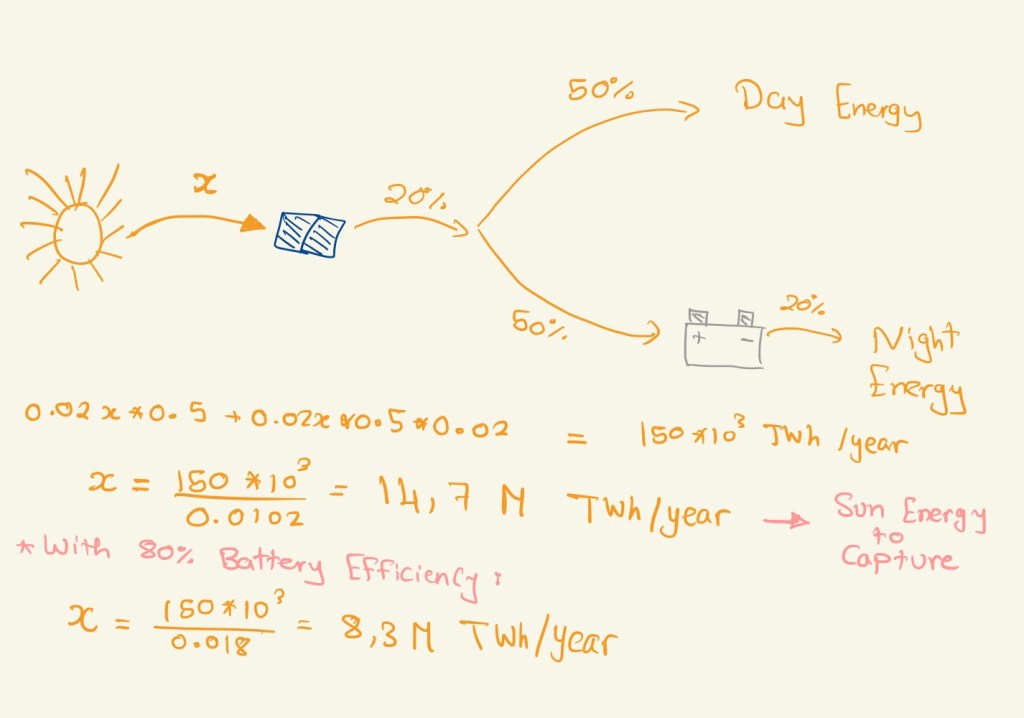
The above schematic represents the energy flow in a solar panel. Due to the intermittency of day and night cycle, we assume that 50% of the energy generated by PV is to be consumed directly, and 50% is to be stored to be used at later time. Assuming 20% efficiency of PV and 20% of a battery system we discover that already in 2021, we need to absorb 14,7M TWh/year to cover our 150,000 TWh annual energy need.
This means that already in 2021 we would need to cover 67% of the Sahara Desert with PVs (not accounting for area needed by battery systems) to cover our needs. Considering our 3% compound growth rate, in Eq. 1, we find that covering the whole Sahara will not be enough in just 15 years.

Taking the global average annual horizontal surface irradiance of 


Given our current technology, we can expect that in just 90 years, we will have to cover the entire Earth with PVs to cover our needs. Even assuming a 100% end-to-end efficiency we would just have 250 years. This does not take into consideration the amount of land needed for the battery systems, the huge amount of lithium, copper, and steel needed to produce this amount of energy. Clearly, this solution is not very scalable.
📡 Enter Space Based Solar Power
Space Based Solar Power(SBSP) or Space Solar Power(SSP) for short is a technology that has the potential to transform humanity. Not only can it sustainably cover all our energy needs, but it can also make us a multi-planetary species.
The idea is relatively simple, we send a satellite to space, harvest solar energy there and beam it down in abundance to a receiver on Earth either through microwaves or laser.
Because the sun is always there in space (GEO Synchronous Orbit) and the energy is not affected by weather conditions or day and night cycle, the amount of energy available is huge. It is expected that the energy we can collect in space is 43x higher than what we can collect on Earth. The ground area needed for a receiver, even with our current technologies, compared to a traditional solution is between 10x – 20x lower, this is mainly due to very high efficiencies in converting microwaves(up to 91%) and laser(up to 70%) back to electricity.
Imagine what we can do with that amount of energy!
SPS also paves the way for us to conquer space and end all the scarcity and suffering we go through due to our limited resources here on Earth. First, it provides the energy infrastructure needed -both thermal and electrical- for the industrialization of cislunar space as well as powering lunar bases and deep space missions.
For example the ISS operates only with 100kWh with the price for each kWh around $100(almost 1000x the price on Earth), this severly inhibits any more ambitious space projects.
Moving industry to space will unlock trillions of dollars worth of raw materials that can be extracted at much lower energy, due to lower gravity fields, while moving all the polluting industries out of Earth. If you think about, we might end up saving energy and consuming less by doing this!
Second, SPS can provide energy to rural and isolated areas at a competitive cost and with much faster response time, providing power even simultaneously at multiple regions. This can help developing countries skip decades of developing energy infrastructure that has no long-term future and avoid further competition among countries for finite terrestrial energy sources.
Another attractive use case would be directly using space solar power to produce fertilizers, fuels, or other useful chemicals. A huge opportunity here would be using SSP to power the electrolysis of water to produce hydrogen fuel to power airlines. This can make aviation carbon neutral.
Third, Space Solar Power can already provide direct value to people living in isolated geographies or hostile environments. This could be for example scientists in Antartica, where the cost of energy are significantly higher and full with logistic challenges, or for soldiers on the battlefield. It is estimated that two thirds of the coalition deaths in Iraq and Afghanistan was during fuel transportation activities.
Finally, the capabilities that will be developed to implement SSP; e.g., reusable launch vehicles, and in-space assembly, would be invaluable for deep space exploration, satellite building, power beaming, solar energy collection, space robotics, in-space transportation, and energy conversion and storage.
 Omar Hedeya